

Rep. John Hughes of District 13, who wrote Amendment L, joins Dave Roetman to explain why changing the South Dakota Constitution should take 60% of the vote instead of a simple majority. Hughes says that with low turnout, a small share of registered voters can amend the Constitution, which he calls the tyranny of the minority. He says Amendment L applies to every constitutional amendment, whether it comes from citizens or the Legislature, and leaves the right to initiate and refer laws untouched. He points to distinctive protections in the state Bill of Rights, including right to work, the secret ballot and the right to bear arms, and recalls the 2020 marijuana amendment and Marsy’s Law. Hughes rejects the L-No ads’ claim that billionaires back Amendment L, criticizes out-of-state money and paid petition circulators, and urges voters to get informed.
Topics: Amendment L, 60% threshold, South Dakota Constitution, Bill of Rights, direct democracy, initiated measures, recreational marijuana, Marsy’s Law, L-No ads, out-of-state money, paid petition circulators
Rep. John Hughes of District 13 wrote Amendment L. He sat down with me to explain what it does, what it doesn’t do, and what the L-No ads get wrong.
“So, Amendment L simply raises the threshold from 50 percent plus one to 60 percent. That’s it.” - Rep. John Hughes
Right now, a simple majority of the ballots cast can change the South Dakota Constitution. Rep. Hughes calls that “the tyranny of the minority”: when turnout is low, a small share of registered voters can rewrite our founding document.
Amendment L raises that bar from 50 percent plus one to 60 percent. That’s it. As Rep. Hughes explains, it applies to every constitutional amendment, whether it comes from a citizen petition or from the Legislature, and it doesn’t touch your right to initiate or refer ordinary laws. It’s still a much lower bar than amending the U.S. Constitution, which takes two-thirds of Congress and three-fourths of the states.
Rep. Hughes walks through protections in our state Bill of Rights, including right to work, the secret ballot, no taxation without consent, and a right to bear arms that is more specific than the Second Amendment. He argues any of them could be changed today by a bare majority. We also cover the 2020 marijuana amendment, Marsy’s Law (which had to be fixed two years after it passed), and the paid petition circulators who work South Dakota ballot drives.
He also takes on the L-No ads. He says there are no billionaires behind Yes on L, just volunteers and South Dakota groups like the Retailers Association and South Dakota Right to Life, and that the L-No side is the one paying for professional ads.
I agree with him. Vote Yes on L. And, as we said at the end: hell no on L-No.
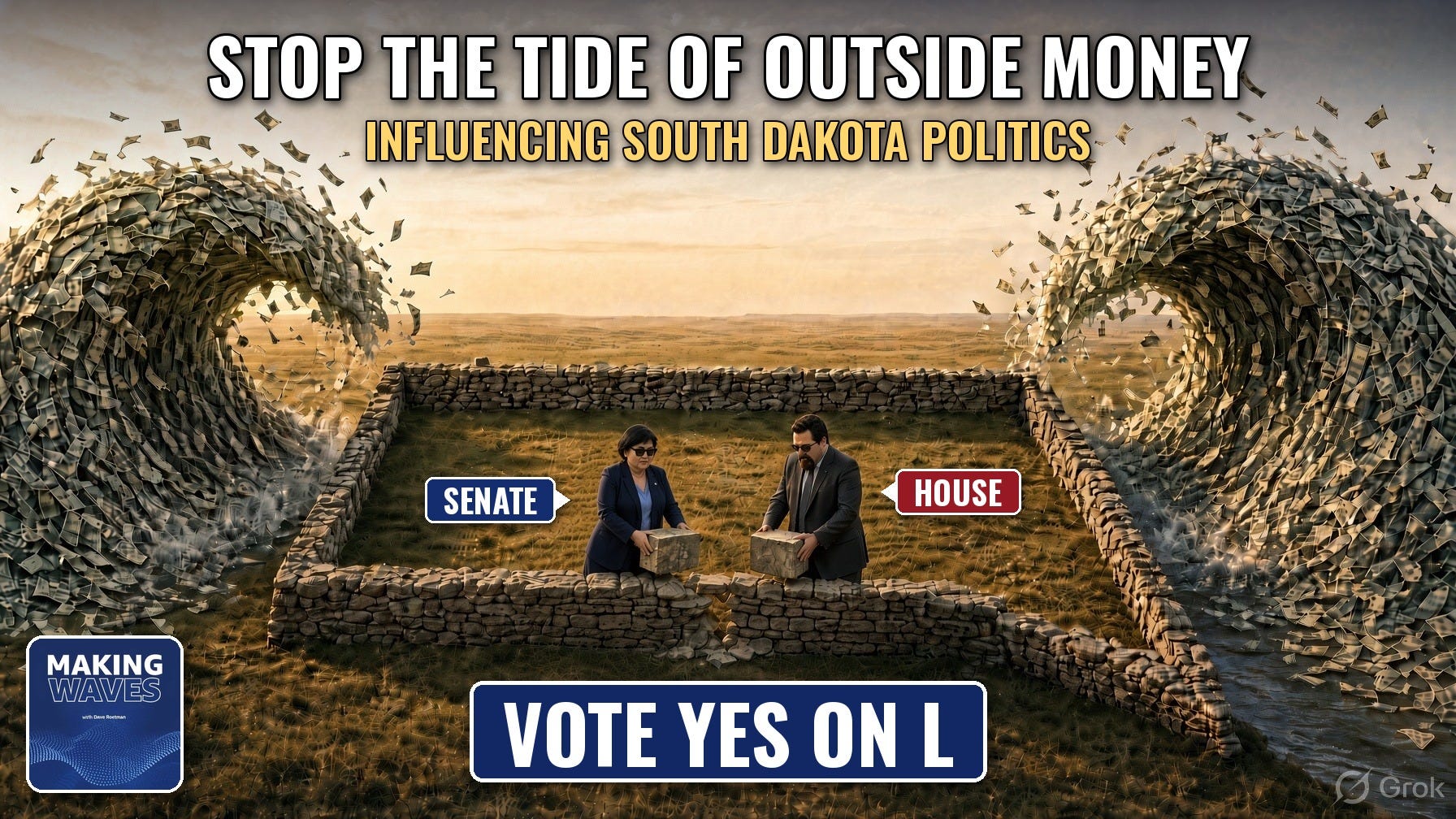
Stop the tide of outside money. Vote Yes on L.
In this episode
[00:28] How our Constitution gets amended today, and “the tyranny of the minority”
[01:30] Lessons from the 2020 recreational marijuana amendment (Amendment A)
[03:46] The L-No ads, and who’s really behind Yes on L
[06:42] What Amendment L does, and what’s at stake in our state Bill of Rights
[09:03] 1898, populism, and why L doesn’t touch initiated or referred laws
[12:05] Marsy’s Law and the problem with long, policy-heavy amendments
[16:21] Paid petition circulators and outside money in South Dakota campaigns
Read Amendment L for yourself on the Secretary of State’s website: Attorney General’s statement on Amendment L (see also the 2026 ballot questions page and the pro/con pamphlet).
Links
HJR 5003 (2025): the joint resolution that put Amendment L on the ballot, with the full text and roll-call votes
Rep. John Hughes, District 13: LRC profile, bills and committees
HJR 5003 - Raising the Threshold to Change the Constitution: Rep. Hughes’s first visit to Making Waves, January 2025
If this episode was useful, subscribe so you don’t miss what’s coming before the Nov. 3 election, and share it with a friend who hasn’t made up their mind on Amendment L.
Full transcript
About this transcript: It was machine-transcribed in-house and then edited for readability. Filler words and false starts are removed, and the meaning is unchanged. [?] marks a word or phrase we’re unsure of. Timestamps are approximate.
[00:00]
Dave Roetman: This is the Making Waves Podcast. My name is Dave Roetman. We’re here with John Hughes, representative of District 13. Welcome, John.
John Hughes: Thank you, Dave, and thank you for asking me to be here.
Dave Roetman: Absolutely. Thank you for being on. We’re here to talk about ballot initiatives and constitutional amendments, specifically Amendment L. So could you tell us a little bit about the process of amending the Constitution?
John Hughes: Wonderful. Currently the way our Constitution is structured, a citizen-initiated constitutional amendment can be enacted, become law, in our Constitution by the simple majority vote of the ballots cast at the election. And so, for example, we have about 600,000 registered voters. Actually, I think Ballotpedia says we have 624,000. So... If we have a fifty percent, voter turnout, which frankly is foreseeable, then three hundred thousand people that cast ballots for an amendment.
Of... No. So. Will determine the fate of that amendment and a simple majority of course plus one would be 150,000 votes plus one. So currently a constitutional amendment could become law essentially by what I call the tyranny of the minority because we have an unusual structure in that some states require a percent of registered voters. And based on what I’ve observed since 2018 in South Dakota and especially after we went through the marijuana, so-called recreational marijuana.
Amendment which would have added, well, it did add 10,000 words. 10,000 words! To our Constitution, if you can believe that.
Dave Roetman: Now, could you pause there? That was 10,000 words. A lot of them really didn’t have anything directly to do with their legalization. It was just a bunch of junk that they threw out there.
John Hughes: Yeah, people would be surprised to know that if you want to grow some tobacco plants in your backyard, federal law exclusively we. See ya later. Does not regulate growing tobacco in your backyard for your own personal use.
Dave Roetman: I like that. I like smoked cigars.
John Hughes: Well, there you go. And so actually, I mean, there’s kind of a cottage industry that’s developing out there. If you go on the social media, YouTube, you’ll see that there’s a lot of people that are doing just that, and they’re visiting some traditions that go back to colonial... But the difficulty is, I mean, you could sort of quote Ronald Reagan because, you legalize something and then you give it preferential treatment, perhaps, you may subsidize it, and if it fails...
Then, if it stops moving, you subsidize it, I think is its quote. I’m not doing a good job of quoting President Reagan, but I was floored to read the amendment in 2020 because I thought, wow. I thought recreational marijuana was about a person 21 or older that wants to grow a few plants in their backyard for their personal use and I did not support recreational marijuana. I didn’t because of the way it went about.
There was two million dollars that came from a Washington DC PAC [?] to support so-called recreational marijuana.
Dave Roetman: This was Amendment A, correct?
John Hughes: That was Amendment A.
Dave Roetman: They had some very deceptive campaigning when they were doing Amendment A. They tried to pretend it was all about growing legal hemp. They tried to pretend it was about other stuff, medical marijuana, but it was really about recreation.
John Hughes: The L-No folks are lying to all of us. They think we’re stupid. There are no California billionaires. There are no billionaires. The Amendment L is being supported by several conservative nonprofits along with the South Dakota Retailers Association. Protect South Dakota Kids has been studying the marijuana issue for years and that that’s their interest is to prevent us from facing another recreational marijuana attempt. South Dakota Family Voice obviously is concerned about things like parental rights and things like unrestricted abortion being added to the Constitution.
And South Dakota Right to Life is involved. There’s about 14 of us. We’re all individuals. Nobody...
Dave Roetman: None of you are billionaires. None of us are billionaires. That is a brazen lie. When I saw that on YouTube for the first time, I was like, what are you talking about? If there was any billionaires involved, I’d be... And there is no money to support the guys on L.
John Hughes: And not only that, but they even timed their organizational paper filing with the Secretary of State on June [?] 8th, which was after the primary.
[05:00]
And this allows them to... Avoid filing campaign finance reports until about 12 voting days before November 3. So these folks are anything but dumb.
Dave Roetman: They are calculated. And they’re professional. Those are very professional as they’re putting out. They’re the ones spending all the money. Yeah. Kasey Marshall [?].
John Hughes: Is the head, the committee chair. She was probably one of the strongest proponents of adding Amendment G to enshrine unrestricted abortion in our Constitution. We have a gentleman who apparently works for SDEA, Ryan Rolfes [?]. An sdea.org email domain which floors me frankly. Why would, I mean, our educators should teach our kids they shouldn’t be engaging in waging ideological wars by essentially misleading. A small minority of our voters. And they also have a disincentive to educate voters because they want people to stay sleepy and stay home.
Stay on your couch, watch Netflix, think everything’s hopeless, I’m too cynical to vote. And so the more people stay home, the more likely it is that we’re going to face a continuation of the barrage of citizen-initiated constitutional amendments that have been proposed since 1988.
Dave Roetman: So let’s talk a little bit about Amendment L, what exactly it does, and how that will change South Dakota politics. For example, I’d like to point out that changing the Constitution, U.S. Constitution, is actually a difficult process. You’ve got to get, what, two-thirds of the states and two-thirds of the Senate minimum to change the Constitution? It’s.
John Hughes: Actually two-thirds of the House, two-thirds of the Senate, and then three-fourths of the states have to ratify.
Dave Roetman: My mistake. So it’s even more harder [?]. But on South Dakota, you can change the Constitution with a simple majority.
John Hughes: Yeah, and every South Dakota citizen should take out their Constitution. And look up Article 6, the South Dakota Bill of Rights. It has 29 sections, and a number of them go beyond. In fact, my goodness, 1, 2, 3, 4, 5, 6, 7, 8, 9, 10, 11, 12, 13. 13 of them go beyond, or are distinctive to our South Dakota Constitution when you compare it to the United States’ [?] Bill of Rights [?] and the Constitution.
Like, we have the right to work.
Dave Roetman: We have... And several years ago, we had outside South Dakota groups. From Chicago. I remember I was fighting this back in 2016. These are Chicago labor unions. We’re trying to take away our.
John Hughes: Right to work in South Dakota. This is what we’re facing, Dave, and I know you have long whiskers, so to speak. Well, ten years I think you’ve been a student of the ballot initiatives.
Dave Roetman: Yes. Absolutely. Back in 2016, I had two interns, $1,500, and a large target list that we managed to take out in some of these ballot initiatives.
John Hughes: We have a secret ballot. We have taxation only with consent. Property tax, the taxes have to be equal in uniform. So what if we amend that and then we end up with an income tax or something worse? So I... Amendment L simply raises the threshold from 50% plus one to 60%.
Dave Roetman: Plus one. That’s it. It.
John Hughes: Took me about 10 minutes. And eight minutes was pulling it up on my screen. Yeah, maybe eight and a half.
Dave Roetman: So it’s the kind of legislation, or actually Constitution [?] Amendment, like simple, not hundreds of pages.
John Hughes: Yeah, there’s nothing simple about it. And I have to tell people, this is kind of boring in a way. I mean, political science, just the study of government process can be kind of boring, unless you have Unless you have professors that can put it in historical contexts, where people have fought over things, then it comes alive. So, let’s make it come alive. South Dakota joined about 20 other states in 1898. There was a rise of populism during the very end of the 19th century.
A lot of it had to do with the fear over railroads, and how that was going to affect property rights, frankly.
Dave Roetman: That’s a legitimate fear.
John Hughes: It’s a legitimate fear and so you know we were we just happened to be the first but we were you know when people say we have 127 128 year history of you know blanket initiative and referendum they’re long because what we in 1898 we acquired in our constitution the right to have citizens initiate laws, statutes, and we also put in our Constitution the right of citizens to refer statutes.
[10:00]
Remember the landowner’s bill of rights and referred law 21? Well, we, that’s a, what should I say, that’s a living example of a workshop of how our constitutional structure.
Dave Roetman: Genuine grassroots.
John Hughes: Absolutely. Now, the right of citizens to initiate statutes and to refer statutes is completely unaffected by Amendment L. Amendment L only applies to constitutional amendments, whether they’re initiated by the citizens or the legislature. And I had people tell me why the legislature should have an easier path. And I’m like, no, we need to make this uniform. What’s good for the goose is good for the gander. Let’s apply it both ways, but the message of direct democracy is really, it’s stretched beyond its limits by the L-No folks.
We are not losing direct democracy. I don’t know why recreational marijuana was a ballot. Amendment to the Constitution when medical marijuana was an initiated measure.
Dave Roetman: I recall that. Yeah, it’s.
John Hughes: Backwards. You can see they’re all meeting in a room. I mean, seriously, maybe they’re doing it on Teams or Zoom or whatever, but they’re all sitting in a room and they’re going, now how can we play this?
Dave Roetman: They’re probably on Zoom because they’re getting their money from the East Coast. So they have to bring in their funders from New York and Massachusetts. So.
John Hughes: I watched 2018 happen and then followed by 2020. And then the whole eminent domain thing, an amendment G on abortion. And I just thought to myself, people don’t understand that our Bill of Rights could be changed by a simple majority of the ballots cast by those who show up. To vote. If that doesn’t make your blood run cold, then you may want to check your pulse. We.
Dave Roetman: Have a couple of, well, more than one, example of bad constitutional amendment changes, like Marsy’s Law, which sounds like a good idea, but it had so many issues.
John Hughes: We.
Dave Roetman: Had to amend it two years later.
John Hughes: Dave, I’m so glad you said that because What’s happened is that a view-based ideological policy is being promoted to be added to our Constitution. I mean, the interpretive challenges of the courts are... Are exponentially made more difficult when you add, I mean read the existing 29 Bill of Rights. They’re one sentence. Until you get to Marsy’s Law, then you run into this big blob of text.
Dave Roetman: Now I think that’s actually a strategy. I think it’s called the Cloward-Piven strategy where you put, you make something broken and so it overwhelms the system and you break it and once the system is broken you can rebuild it from the ground up the way you want it. And so what they’re doing is that we have a nice, simple Constitution which anybody can read. You have an eighth-year education, you can read our Constitution and understand it.
10,000 words into it then all of a sudden you need a lawyer to interpret everything and frankly, it’s So. Thank you very much. Thank you.
John Hughes: The lawyers that have to speak up and that’s why you know I’ve been practicing law in South Dakota for 42 years all of those years in Sioux Falls and I can’t sit back and watch this play out and not speak up because you know even if you say okay 2018, we left the simple majority in place, but take a look at the 2018 ballot and look at the, three other direct democracy, the constitutional amendment initiatives.
One was the single subject rule. And I don’t have my papers in front of me. They made sense. And I think by the time, by the time they got to 55 % I think what they were saying is, Hey, we’ve done enough to shore up the Constitution. Thank you. Thank you. And we don’t need to go further. But, well, now, I mean, in the world of PACs and super PACs, and following the Citizens United decision-giving corporations, the right of political speech.
Each. Thank you. My goodness, folks, it’s, like I said, I mean, I like Netflix, but you might want to check your viewing history. If you’re spending more than, I don’t know, an hour a day or something like that, you probably ought to do two other things, check up on your family and then make sure you’re informed because we don’t have newspapers anymore. We don’t have the we don’t have an independent body of journalism now we have you know basically we’re in the gig economy and social media and so we don’t have the self-restraint [?] that used to be demonstrated by people that were communicating on issues of public concern through what used to be the traditional media channels.
[15:00]
And so this is my plea for people is please get informed. Support Amendment L. Tell the L-No folks. I mean, they’re the people because you have a group of citizens that are, nobody’s making any money at this. We’re losing everybody is full time. And we have this just distasteful undignified defamatory saturation of the radio. Airwaves they’re spending lots of money on this and where they’re getting their money.
And you know they’re getting paid. I’m not getting paid. You’re not getting paid. It’s just defamatory what they’re doing saying outside billionaires are paying for this BS. We tried to outlaw or is in the article that he wrote along with a couple other people that was published in the USD Law Review, it just seems to me that when you read it, and you can judge for yourself, what his real beef is about Amendment L is that it’s going to make it more difficult, and they’ll have to hire more paid petition circulators to bamboozle the people.
I mean, I was in front of the post office, in war. There’s always two of them [?], and they always have more than one petition. When you look at them, being a native South Dakotan, I know they’re not from around.
Dave Roetman: Here. I can tell you for certain, because I used to track these things. I’m in politics semi-professionally, and I used to follow them around. They would have Michigan, Minnesota license plates. They’re not South Dakotans. They didn’t speak like South Dakotans. And if you asked them to talk to them about it, they even got offended if you suggested they were from South Dakota. And you’re right. This is a paid gig for them, right?
Are they paid per signature?
John Hughes: Well, technically not. Because technically that, I believe, is against the law. But they get paid well per [?] hour [?], and then they get bonuses for bringing in extra. So they’ve got a strong... Incentive.
Dave Roetman: Yeah, but to get as many signatures as they want and they will lie to you Yeah about what the petitions about they will say something nice right sign this.
John Hughes: Well recreational marijuana.
Dave Roetman: Oh, yeah, that was now that was just to give farmers the ability to grow him so they can make clothing.
John Hughes: Actually, you know what? Come to think of it. I’m having a déjà vu moment at the Lincoln County Courthouse. Of course. It’s going to be great. And that’s it. And after I read what they were proposing. But we’re so compliant and trusting. And we’re nice. Oh.
Dave Roetman: I’m going to be nice to you and sign your petition just because I’m nice. So stop that. Yeah. You support health care for.
John Hughes: Women. And then it’s unrestricted. I mean, it’s unrestricted abortion. Potentially conception to after live birth. It depends on how you define perinatal, and you know California and New York. Wow. They’re defining, be afraid of the word perinatal. Whenever you see perinatal, that extends beyond birth. And I’m not a doctor, and so ask a medical professional.
Dave Roetman: Well, the left has been talking about that for years now. Yeah, somehow they think.
John Hughes: That drugging our children and aborting them is a virtue. And when our education system... Arguably might have some connection to some of the people that are going to open the door to more of this, to more of that. We ought to be concerned about affordability. We ought to be concerned about our literacy rates in South Dakota, which are... In the I think low 40s of proficiency in math and science. We need to teach kids how to balance their checkbook, how to avoid debt.
I mean, that’s really our state, instead of trying to bamboozle the people and say, well, we’re going to get taxes. I mean, where have you heard that? I voted for historic Deadwood gambling. And we’re supposed to go for education. That money goes in the general fund. It’s never gone toward education directly. There’s no guardrails. And we’re so forgiving and we have short-term memory problems.
Dave Roetman: People have to remember that governments are always predatory. And we have to be in control of the government. And one of the ways to do that is to make sure that any changes to our Constitution get a 60% minimum vote before the Constitution gets changed.
[20:00]
John Hughes: Well, I know our founders would look at our state Constitution and they’d look at our 29 Bill of Rights and they’d go, touche, well done. . And then they’d say, wow, you’ve lasted this long with a simple majority?
Dave Roetman: Well, that’s one of the points I was going to make before. A hundred years ago. 128 years ago, whatever it is, we didn’t have, South Dakota had people from the East Coast, whatever it is, shoveling millions of dollars into South Dakota trying to change our government. They didn’t care about us back then. But now. It’s so easy to transfer money. A half a million dollars and a million dollars in. South Dakota goes a long ways and it doesn’t go very far in Boston or...
New York or any of the East Coast cities. So they’re happy to send the money here and have it have a huge impact on a red state that they really don’t like.
John Hughes: Well yeah, J.B. Pritzker in Illinois sent I think $750,000 to put abortion in our...
Dave Roetman: Yep. That’s the outside.
John Hughes: Billionaire. Well, I remember not long ago, a certain reporter with a newspaper in Sioux Falls liked to sort of, not very kindly, but kind of scoffingly refer to South Dakota as flyover country. Frankly. I’d like to go back to a little bit of that because we are, it’s almost like we’re the South. We’re the post-Civil War South and the carpet baggers are showing up. You know only you know obviously we haven’t been through a civil war thank god but the bottom line is is that there are people that see massive profit opportunities you know whether it’s you know and the and these topics always show up right on the eve of the session Whether it’s a pipeline or it’s marijuana or it’s gambling or it’s repealing our usury laws.
In South Dakota we have literally turned our culture and our morals and our values inside out to accommodate the influx of huge amounts of capital. That profits in South Dakota, but I’ve never seen it trickle down. I’m still waiting for the trickle. Have you seen the trickle day?
Dave Roetman: I have not. Well, the people who do these ballot initiatives professionally, they get the trickle. Okay, all right, that’s where it’s going. I’m getting a couple million a year. All right, so they step up to the.
John Hughes: Leaky drinking fountain and have a few drops. Honestly, they’re getting little pittance. Yeah, they dip their beak. Big money to them. Isn’t that a mob to dip your beak? I think it is.
Dave Roetman: I don’t do me. I rule all of it.
John Hughes: Oh, what else? It’s, the stakes are high. I mean, I know people say that and a lot of times it’s hyperbole or it’s exaggeration, but, you can, I guess you can take it from me because I’ve been engaged until the last, very few years, somewhat passively. In direct public policy formulation. But we’ve got to do better, because what did Reagan say? Freedom is about a generation away. Day. Thank you. Okay. And our kids aren’t being taught to revere what we have.
Dave Roetman: And everybody takes it for granted. It’s not passed down on the blunt. Right.
John Hughes: But it’s preserved by each generation to be passed down to the next. Oh, here’s another point that might make people a little uncomfortable too.
Dave Roetman: Go ahead.
John Hughes: Well, our right to bear arms is way more specific. Than the Second Amendment. In South Dakota you have the right to bear arms in defense of yourself and the state. We also define militia, which is really cool. And it’s like, okay, that fills in the gaps on the Second Amendment. The founders knew what a militia was. Our founders in South Dakota knew what a militia was. And so it was one of those things, where you didn’t have to define it.
Like a facial tissue, say Kleenex. Yes. Everybody knows what a Kleenex is. I don’t know what a facial tissue might be. I mean, I have some ideas, but... So imagine our right to bear arms is cut back. Or there’s a Castle, the Castle, Home Is Your Castle doctrine is repealed. Or we want to have people that... And my heart bleeds. There’s a lot of ways a person can sadly end their lives.
Firearms is one of them. But there are a lot of people that, where they want to sit around the table and be subject matter experts on how we should live our lives. I would say this. I mean, there are people that have very fixed beliefs that they know how better than other people know.
[25:00]
To govern their own lives and that they should be a spokesperson you know for the culture and that they espouse the values that everybody should have and I got to tell you we need to run away from those people because the fundamental compact between South Dakota and its citizens is in our existing Constitution. And I believe that if the founders of our Constitution in South Dakota were here today, they would say, hey, why haven’t you done this already?
And my land, we’re raising simple 60%. It’s not like that’s some chasm.
Dave Roetman: It’s important enough that 60% of people vote for it. We’re not even saying... It’s a much lower bar than the feds. It is. It’s a much lower bar than other states.
John Hughes: And there are a number of states, a couple of them are pretty close to us. One’s [?] a sister state. They have no initiated powers at all to initiate statutes or refer laws. And the reason is this. He used to rankle my dad. He was a navy chief in carrier aviation in World War II. It always irked him when people would call our country a democracy. And he’d say, John, we have direct democracy, but the form of government and the three equal branches are a constitutional republic.
Don’t ever forget that. So, the Constitution of the United States guarantees each state. A Republican small r you know for people that are might be partisan you know there is a small r and that’s what we that’s, what we’re trying to preserve. Dave. So no so yes on l. Yes on l. And hell no on L-No. I think that should be our new slogan. Hell no on L-No.
Dave Roetman: Thank you for being with us. It’s the Making Waves podcast. My name is Dave Roetman. We’ve been here with John Hughes, a representative from District 13.
John Hughes: Thanks, Dave.


